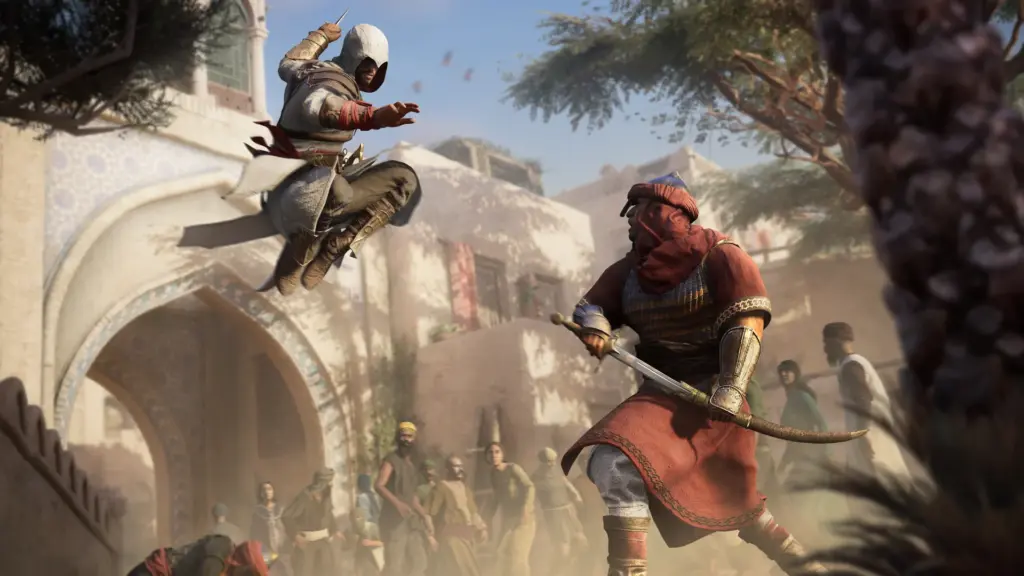
The evolution of the Assassin’s Creed franchise has been a journey of massive proportions, transitioning from tight, rooftop-focused social stealth to sprawling, hundred-hour action RPGs. However, with the release of Assassin’s Creed Mirage, Ubisoft has intentionally pivoted backward, offering a “love letter” to the original 2007 title. For a beginner stepping into this world for the first time, or perhaps returning after a long hiatus, Mirage represents a condensed, focused, and mechanically grounded experience that strips away the bloat of recent entries like Valhalla or Odyssey.
Set in 9th-century Baghdad during the Islamic Golden Age, the game follows Basim Ibn Ishaq, a character players might recognize if they’ve dabbled in previous lore, though no prior knowledge is required to enjoy this standalone origin story. This review explores why Mirage is perhaps the most accessible entry point for newcomers in over a decade, focusing on its refined stealth, historical immersion, and manageable scope.
The Setting: A Lived-In 9th-Century Baghdad
One of the most striking elements of Assassin’s Creed Mirage is its environment. Unlike the vast, often empty landscapes of the “RPG trilogy,” Baghdad is a dense, vertical playground designed specifically for parkour. The city is divided into four distinct districts, including the opulent Round City and the industrial Harbiyah.
The attention to historical detail is backed by extensive research into the Abbasid Caliphate, ensuring that every marketplace, mosque, and hidden alleyway feels authentic. For beginners, this smaller map is a blessing; it prevents the “map fatigue” common in modern open-world games. You aren’t just clearing icons; you are learning the layout of a city, finding the best rooftop routes, and understanding how the urban design dictates your movement.
Gameplay Mechanics: Stealth Over Strength
In Mirage, the philosophy of “Hide in Plain Sight” returns to the forefront. While recent games allowed players to charge into forts like a Viking warrior, Mirage punishes reckless aggression. Basim is relatively fragile, and the combat system is designed to be a secondary option—a “punishment” for failing to stay hidden.
The Pillars of Stealth
- Social Stealth: Basim can blend into crowds, sit on benches, or hire groups of musicians and mercenaries to distract guards. This allows for a more cerebral approach to infiltration.
- Environmental Interaction: Utilizing tall grass, haystacks, and even flower piles is essential. The game encourages players to observe guard patrols using Enkidu, Basim’s eagle companion, before making a move.
- The Assassin’s Tools: You start with the iconic Hidden Blade and eventually unlock a variety of gadgets. Throwing knives, smoke bombs, and noisemakers are not just “extras”—they are survival requirements.
Combat and Parrying
When stealth fails, the combat shifts to a rhythmic parry-and-dodge system. Beginners should note that timing is everything. A successful parry often opens an enemy up for an instant kill, but being surrounded by three or more guards is frequently a death sentence. This mechanical shift reinforces the identity of an assassin: you are a scalpel, not a sledgehammer.
Beginner’s Comparison: Mirage vs. The RPG Era
To help new players understand where Mirage sits in the wider franchise, the following table compares its core features with the more recent, larger-scale entries like Assassin’s Creed Valhalla.
| Feature | Assassin’s Creed Mirage | Recent RPG Entries (Valhalla/Odyssey) |
| Game Length | 15–25 Hours | 80–120+ Hours |
| Map Size | Small, Dense City (Baghdad) | Massive Countries (England/Greece) |
| Combat Focus | Tactical, Defensive, Stealth-First | Action-Heavy, Ability-Based, RPG-Lite |
| Progression | Linear Story & Tool Upgrades | Leveling, Gear Loot, Complex Skill Trees |
| Stealth | Primary Mechanic (Social & Classic) | Secondary/Optional Mechanic |
| Parkour | Fast, Fluid, Vertical | Functional, but often simplified |
Understanding the Investigation System
Mirage does away with the traditional quest log filled with fetch quests. Instead, it utilizes an Investigation Board. This system feels more like actual detective work, where you gather clues about the Order of the Ancients—the shadowy antagonists of the series—to uncover their identities and locations.
For a beginner, this provides a clear sense of purpose. You aren’t just checking boxes; you are dismantling a conspiracy piece by piece. Each major “Black Box” mission (a term used for open-ended assassination targets) allows you to choose your approach. You might find a secret entrance, bribe a servant for information, or create a chaotic distraction to lure your target into the open. This player agency is where Mirage truly shines as a narrative-driven action-adventure.
Technical Performance and Visuals
From a technical standpoint, Mirage is built on the Anvil Engine, the same engine that powered Valhalla. However, because the scope is smaller, the developers have been able to pack more detail into the urban environments.
- Graphics: The lighting in Baghdad is spectacular, especially during the “golden hour” at sunset. The character models are sharp, though some animations can feel slightly stiff compared to modern motion-capture standards.
- Performance: On current-gen consoles (PS5 and Xbox Series X), the game runs at a smooth 60 FPS in Performance Mode. PC players will find that the game is well-optimized, requiring modest system specs compared to other 2023–2024 AAA releases.
- Soundtrack: The score, composed by Brendan Angelides, heavily features traditional Middle Eastern instruments, grounding the player in the 9th-century setting and heightening the tension during stealth sequences.
Expert Tips for First-Time Assassins
If you are just starting your journey in Anbar and Baghdad, these actionable insights will help you master the Hidden Ones’ ways:
- Upgrade Your Tools Early: Focus on upgrading your Throwing Knives to pierce armor and your Smoke Bombs to have a wider radius. These are your most reliable “get out of jail free” cards.
- Manage Your Notoriety: As you commit crimes, your notoriety bar fills up. At higher levels, citizens will recognize you and call the guards. Use Power Tokens to bribe town criers or rip down “Wanted” posters to keep a low profile.
- Use Enkidu Wisely: Your eagle is not just for scouting; she can mark enemies and find hidden entrances. Be careful, though—marksmen on rooftops can shoot her down, forcing you to rely on your own “Eagle Vision” (a supernatural pulse that highlights enemies through walls).
- Don’t Ignore Contracts: Visit the Hidden Ones’ bureaus to pick up contracts. These side missions provide essential resources for gear upgrades and offer unique challenges that hone your skills.
FAQ: Common Questions for Beginners
Is Assassin’s Creed Mirage a sequel to Valhalla?
Chronologically, it is a prequel. It tells the story of Basim about a decade before the events of Valhalla. While it provides context for his character, it is a self-contained story that works perfectly as a standalone experience.
Do I need to play the older games to understand the story?
Not at all. While there are Easter eggs and lore connections for long-time fans, the central plot of Basim’s rise from a street thief to a master assassin is clearly explained within the game.
Is there a “Modern Day” storyline?
Unlike previous entries that frequently pulled players out of the historical setting to play as a character in the present day, Mirage keeps the modern-day segments to a bare minimum—mostly just a brief introduction and conclusion.
How difficult is the combat?
The combat is “harder” than recent games because Basim cannot take many hits. However, the game offers three difficulty settings, so beginners can adjust the experience to focus more on the story if they find the parry windows too tight.
Conclusion: A Masterful Return to Basics
Assassin’s Creed Mirage is a refreshing departure from the trend of “more is better” in gaming. By narrowing its focus to a single, beautifully realized city and returning to the franchise’s core identity of stealth and parkour, Ubisoft has created a game that feels both nostalgic and modern.
For beginners, it serves as the perfect introduction. It isn’t an intimidating 100-hour commitment; it is a focused, high-quality adventure that respects your time. Whether you are scaling the heights of the Palace of the Golden Gate or silently navigating the crowded souks of Karkh, Mirage delivers a sense of atmosphere and tension that defines the best of the series. If you’ve been looking for a way to enter the world of the Hidden Ones, there is no better place to start than the sun-drenched streets of Baghdad.
Assassin’s Creed Mirage: Beginner’s Guide & Tips
This video provides an excellent visual walkthrough of the core mechanics, helping new players visualize the stealth and parkour systems discussed in this review.