The landscape of superhero video games was fundamentally altered in 2018, establishing a new gold standard for kinetic gameplay, emotional storytelling, and open-world fidelity. Fast forward to the current console generation, and the highly anticipated sequel arrives not just as a continuation of a beloved narrative, but as a definitive showcase of modern gaming hardware. Marvel’s Spider-Man 2 on the PlayStation 5 represents a monumental leap forward in interactive entertainment. By seamlessly intertwining the destinies of Peter Parker and Miles Morales, the developers have crafted an experience that expands upon every foundational pillar of its predecessors. This comprehensive analysis delves deep into the graphics, narrative depth, and gameplay mechanics that solidify this title as a defining benchmark for the action-adventure genre.
The Visual Leap: Graphics and Technical Marvels
When evaluating the technical prowess of a current-generation exclusive, the expectations are astronomically high. Marvel’s Spider-Man 2 meets and exceeds these expectations by utilizing the PlayStation 5’s architecture to its absolute limits. The visual presentation is not merely about higher resolution textures; it is about creating a living, breathing digital ecosystem that reacts dynamically to the characters inhabiting it.
Harnessing the Power of Ray Tracing
Perhaps the most significant visual achievement is the implementation of ray-traced reflections across all visual modes. Unlike earlier titles in the console cycle that forced players to choose between smooth frame rates and advanced lighting, this game incorporates hardware-accelerated ray tracing universally. Whether gliding past the mirrored glass of Manhattan skyscrapers or fighting in rain-slicked alleyways, the reflections are geographically accurate and structurally flawless. Technical breakdowns by platforms like Digital Foundry have extensively documented how this universal ray tracing implementation represents a paradigm shift in console rendering, ensuring that the visual integrity of New York City remains uncompromising, regardless of the chosen performance profile.
Visual Fidelity versus Performance Dynamics
Players are presented with sophisticated display options tailored to modern television capabilities. The standard Fidelity Mode targets 30 frames per second (fps) at a native 4K resolution, pushing the boundaries of pedestrian density, traffic volume, and intricate hair strand physics. Conversely, the Performance Mode targets a blistering 60 fps by utilizing a dynamic resolution scaling technique, ensuring combat and traversal remain fluid without sacrificing the overarching visual splendor. Furthermore, for users with 120Hz displays and Variable Refresh Rate (VRR) capabilities, the game unlocks uncapped frame rates, providing a remarkably responsive experience that blurs the line between cinematic animation and interactive gameplay.
Expanding the Concrete Jungle
The map size has nearly doubled compared to the first installment, expanding beyond Manhattan to include the vibrant boroughs of Brooklyn and Queens. This geographical expansion introduces diverse architectural styles, lower-lying residential areas, and distinct neighborhood atmospheres. Moving from the towering high-rises of the financial district into the tree-lined streets of Astoria requires an adjustment in traversal strategy, adding a layer of environmental awareness to the gameplay. The inclusion of the East River is not merely a geographic boundary but a traversal playground, beautifully rendered with realistic water displacement and dynamic lighting that shifts convincingly with the game’s time-of-day transitions.
Traversing the Open World: Gameplay Mechanics and Evolution
At the heart of the Spider-Man experience is the sheer joy of locomotion. The fundamental act of swinging through the city was already highly refined, yet the sequel introduces mechanics that dramatically alter the pace and verticality of exploration.
The Introduction of Web Wings
The most transformative addition to traversal is the Web Wings. Integrated flawlessly into the suits of both Peter and Miles, these deployable gliders allow players to catch wind currents and aerodynamic tunnels scattered across the city skyline. This is not a replacement for web-swinging but a vital companion mechanic. Players must chain traditional pendular swings with the soaring aerodynamics of the Web Wings to maintain momentum. According to Insomniac Games, the physical calculation of momentum was entirely rewritten to accommodate these faster traversal speeds, resulting in an exhilarating rhythm that makes navigating the expansive map an engaging activity in its own right.
SSD Architecture and Near-Instantaneous Fast Travel
The integration of the PS5’s custom Solid State Drive (SSD) fundamentally changes the pacing of open-world gaming. The fast travel system is entirely devoid of loading screens. Selecting a point on the map results in a nearly instantaneous transition, dropping the player directly into a fluid swinging animation. Furthermore, character switching between Peter and Miles happens in real-time. A simple button press zooms the camera out across the city and seamlessly zooms back into the other protagonist’s location, a technical feat that maintains narrative immersion and showcases the seamless data streaming capabilities of modern hardware. Detailed analysis by tech outlets like The Verge highlights how this specific utilization of SSD architecture eliminates the traditional friction associated with massive open-world environments.
Symbiotes and Bio-Electricity: The Evolution of Combat
Combat in the sequel builds upon the rhythmic, acrobatic foundation of the original while introducing heavy-hitting, transformative abilities that reflect the narrative arcs of the dual protagonists.
Peter Parker: The Brutality of the Symbiote
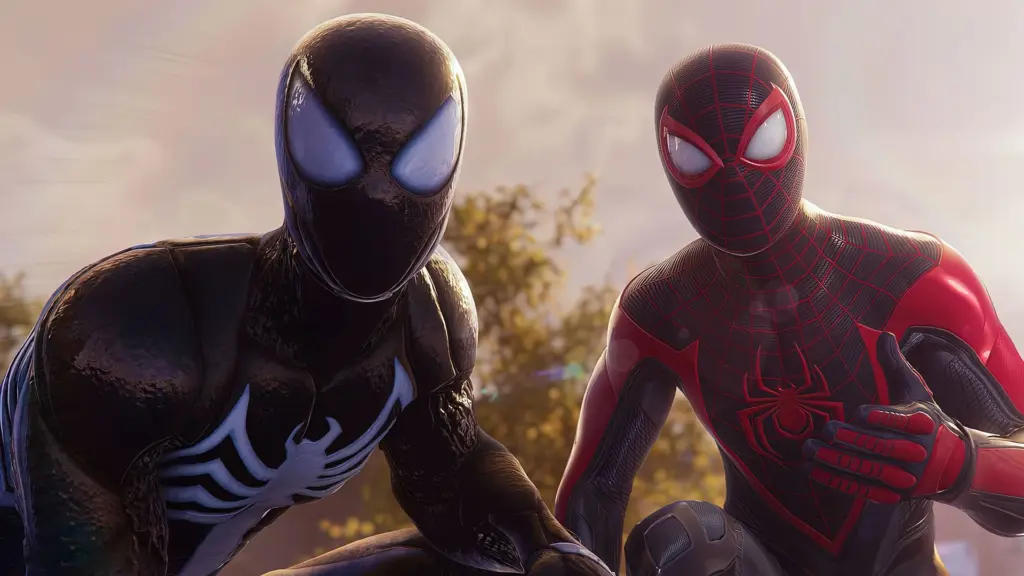
Peter’s combat style undergoes a massive shift with the introduction of the black symbiote suit. Unlike his traditional gadget-heavy approach, the symbiote abilities are aggressive, visceral, and centered on crowd control. Tendrils lash out to grab multiple enemies, slamming them into the pavement with concussive force. This mechanical shift perfectly mirrors Peter’s internal narrative—the suit makes him unequivocally more powerful, but the combat animations grow increasingly brutal and less restrained. Prior to acquiring the symbiote, Peter utilizes mechanical Spider-Arms, which offer excellent defensive and offensive capabilities, but the distinct tactile feedback provided by the DualSense controller emphasizes the raw, biological power of the alien entity.
Miles Morales: Refined Venom Blasts
Miles continues to evolve his unique bio-electrical powers, now categorized as “Venom” abilities (distinct from the character Venom). His skill set introduces new, chain-lightning-style attacks and explosive area-of-effect abilities that are visually spectacular. Miles’ combat is characterized by speed, agility, and battlefield manipulation. The game features three distinct skill trees: one dedicated to Peter, one to Miles, and a shared tree that upgrades core foundational abilities like health, swing speed, and parry windows. The introduction of a dedicated parry mechanic—requiring precise timing to repel heavy enemy attacks—adds a necessary layer of defensive depth to encounters, a feature heavily praised in combat analyses by Game Informer.
A Tale of Two Spiders: Narrative and Character Development
A video game of this scale requires a narrative anchor capable of supporting its massive set pieces. The story woven here is a mature, emotionally resonant exploration of legacy, addiction, and the heavy toll of responsibility.
Kraven’s Hunt and the Catalyst for Chaos
The narrative is initially driven by the arrival of Sergei Kravinoff, known as Kraven the Hunter. Kraven travels to New York not to conquer it, but to find an equal in combat. His heavily armed faction, the Hunters, systematically targets the city’s superpowered individuals—both heroes and villains alike. Kraven is portrayed with a menacing, stoic intelligence. He serves as the perfect catalyst, upending the established order of the city and forcing Peter and Miles to confront threats that test their physical and moral limits. Reviewers at GameSpot have noted how Kraven’s systematic dismantling of the rogue’s gallery creates a persistent sense of dread and urgency.
The Symbiote as a Metaphor for Addiction
The emotional core of the game lies in Peter’s bonding with the alien symbiote. The narrative treats the suit not just as an outfit change, but as an allegory for substance abuse and the corruption of power. As Peter relies more on the suit to handle the overwhelming threat of Kraven, his personality shifts. He becomes abrasive, isolated, and arrogant. This narrative arc forces the player to actively participate in Peter’s descent. The brilliance of the storytelling, as highlighted by narrative critiques from Polygon, is how it utilizes interactive gameplay to make the player feel the seductive nature of the symbiote’s power, making the eventual internal conflict deeply impactful.
Miles Morales: Coming of Age and Forgiveness
While Peter wrestles with internal darkness, Miles faces an equally daunting emotional journey: confronting Martin Li (Mister Negative), the man responsible for his father’s death. Miles’ arc is fundamentally about overcoming trauma, managing vengeance, and truly understanding what it means to be a hero when the emotional stakes are deeply personal. The game masterfully balances the screen time between the two heroes, ensuring that both character arcs intersect meaningfully. The juxtaposition of Peter’s darkest moments against Miles’ struggle to remain a beacon of hope provides a brilliant thematic contrast.
The Open World: Side Quests and Meaningful Distractions
Open-world fatigue is a common issue in modern gaming, often characterized by a map littered with repetitive tasks. Marvel’s Spider-Man 2 actively combats this by ensuring that side activities are narratively contextualized and mechanically diverse.
Streamlining the Grind
The developers have significantly reduced the sheer volume of map markers in favor of higher-quality, multi-stage side missions. Players will investigate Prowler stashes that require environmental puzzle-solving, infiltrate heavily guarded Hunter Blinds, and complete EMF experiments that involve intricate mini-games centered around genetics and robotics. These activities reward the player not just with experience points, but with tangible lore and character interactions.
The FNSM App and Community Impact
The Friendly Neighborhood Spider-Man (FNSM) app returns, allowing citizens to request help directly. These missions range from high-speed pursuits to remarkably grounded, quiet moments—such as helping an elderly citizen or finding a lost pet. These slower, character-driven moments ground the grandiose superhero narrative in the reality of the city they are trying to protect. According to comprehensive reviews by IGN, it is these quiet, humanizing moments that elevate the open-world design, reminding players that behind the mask, these heroes are fundamentally tied to their community.
Detailed Comparison: Marvel’s Spider-Man (2018) vs. Marvel’s Spider-Man 2 (2023)
To truly understand the evolutionary leap, it is vital to contrast the sequel with its groundbreaking predecessor.
Advancements in Core Game Design
| Feature / Element | Marvel’s Spider-Man (2018) | Marvel’s Spider-Man 2 (2023) |
| Playable Protagonists | Peter Parker (Exclusively) | Peter Parker & Miles Morales (Seamless Switching) |
| Map Size & Scope | Manhattan | Manhattan, Brooklyn, and Queens |
| Traversal Mechanics | Web-Swinging, Wall-Running | Web-Swinging, Web Wings, Wind Tunnels |
| Fast Travel Pace | Masked by Subway Loading Screens | Near-Instantaneous (Sub-two seconds) |
| Graphics & Lighting | Screen Space Reflections (PS4 base) | Universal Hardware Ray Tracing across all modes |
| Combat Focus | Gadget-heavy, Dodge-oriented | Symbiote powers, Parry mechanics, Dual skill trees |
| Controller Haptics | Standard Rumble | Advanced DualSense Adaptive Triggers & Haptic Feedback |
| Narrative Tone | Classic Hero Origin & Rise | Darker themes of Addiction, Trauma, and Legacy |
Frequently Asked Questions (FAQ)
1. Is it necessary to play the previous games before starting Marvel’s Spider-Man 2?
While the game features a “previously on” recap to bring new players up to speed, playing both Marvel’s Spider-Man (2018) and Marvel’s Spider-Man: Miles Morales (2020) is highly recommended. The emotional weight of the narrative, particularly Miles’ grief and Peter’s relationships, heavily relies on the established history from the prior installments.
2. Does the game feature cooperative multiplayer?
No. Despite featuring two lead protagonists, the game is a strictly single-player, narrative-driven experience. The developers made a deliberate choice to focus on a highly polished, cinematic solo campaign where character switching serves the story rather than accommodating co-op mechanics.
3. How long does it take to complete the main story?
A standard playthrough of the main narrative campaign takes approximately 15 to 18 hours. For players looking to complete all side missions, unlock every suit, and achieve the Platinum trophy, the total playtime extends to roughly 25 to 30 hours, offering a tightly paced experience free of unnecessary bloat.
4. What display settings provide the best experience?
For players prioritizing visual splendor, the Fidelity mode (4K at 30fps) is stunning. However, the game’s kinetic combat and high-speed traversal highly benefit from the Performance mode (dynamic 4K at 60fps). For televisions supporting 120Hz and VRR, the “Performance 120Hz” mode is widely considered the optimal way to experience the fluidity of the web-swinging.
5. How are the DualSense controller features utilized?
The game makes exceptional use of the PS5’s DualSense controller. The adaptive triggers provide tactile resistance when web-swinging, mimicking the tension of the webbing. Haptic feedback is uniquely programmed for different abilities—the heavy, fluid thud of symbiote attacks feels noticeably different from the sharp, crackling feedback of Miles’ bio-electric blasts.
Conclusion
Marvel’s Spider-Man 2 is a triumph of modern game design, seamlessly blending cinematic storytelling with mechanically flawless gameplay. It stands as a testament to what is possible when developers are intimately familiar with the hardware they are building for. By doubling the size of the map, overhauling the traversal mechanics with Web Wings, and eliminating loading screens entirely, the technical foundations of the game are undeniably impressive. Yet, it is the narrative ambition that truly cements its legacy.
The dual protagonist system is executed with a level of care that ensures neither Peter nor Miles feels like a secondary character. Their intertwining stories of loss, corruption, and redemption elevate the narrative far above standard comic book fare. The introduction of the symbiote fundamentally changes not only the combat dynamics but the very emotional core of the protagonist, challenging players to confront the darker aspects of power.
As aggregate platforms like Metacritic have reflected in their high critical consensus, this title sets an incredibly high bar for the industry. It proves that open-world games do not need to rely on infinite, repetitive content to be engaging, but rather on meaningful activities, breathtaking traversal, and a story that treats its audience with intellectual respect. For owners of the PlayStation 5, it is an essential, foundational piece of software that justifies the hardware investment and leaves an indelible mark on the landscape of interactive storytelling.