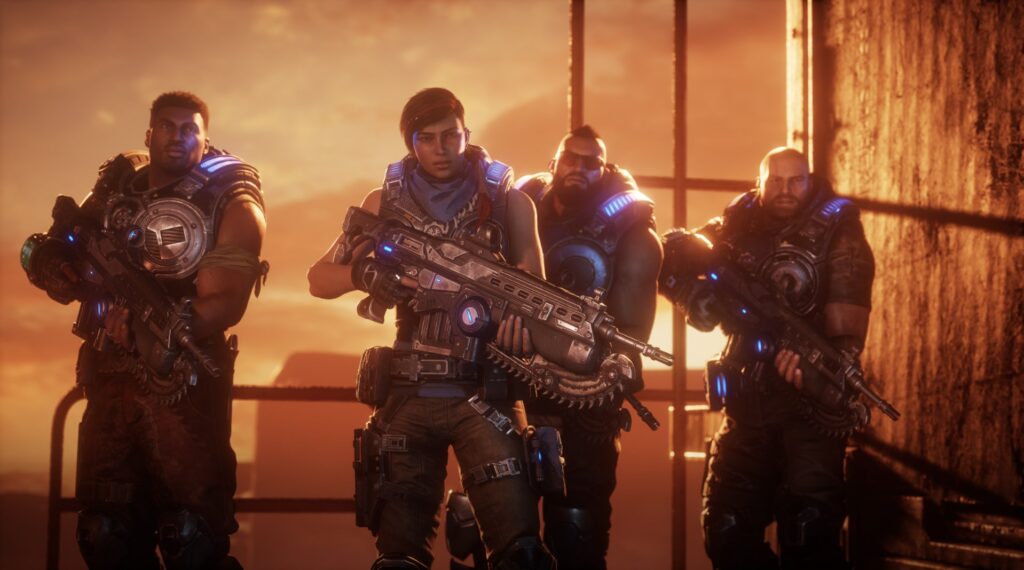
If you’ve just dropped into the world of Gears 5 and found yourself getting chainsawed in half within ten seconds of a match starting, you’re not alone. Gears 5 is a third-person cover shooter with a learning curve that punishes guesswork and rewards those who understand its systems. Released by The Coalition in September 2019, it builds on over a decade of Gears of War history — and while it’s more accessible than its predecessors in some ways, mastering it takes genuine effort, patience, and strategic thinking.
This guide covers everything new players need to know: from the fundamentals of combat and cover mechanics, to character abilities, weapon handling, campaign strategies, and multiplayer survival. Whether you’re here for the story, the co-op Horde mode, or the intense PvP experience, there’s something here for every type of player.
Understanding the Core: Cover Is Everything
The first and most critical thing to understand in Gears 5 is that this is not a run-and-gun game. Rushing into open space without cover is almost always a death sentence. The entire combat system is built around the concept of cover-based movement, which means using walls, barriers, and environmental objects as shields while you engage enemies.
To snap to cover, press A (Xbox) or the corresponding button on your platform. From there, you can blind fire (shooting without aiming, which is less accurate but keeps you protected), peek out to aim precisely, or vault over the cover to reposition. Learning when to do each of these is the difference between a player who survives firefights and one who constantly gets downed.
New players often make the mistake of sticking to one piece of cover for too long. Enemies flank aggressively in Gears 5 — both AI and human opponents. If you’re getting shot from multiple angles, that’s a signal to move. Press A toward another piece of cover to roadie run and re-engage from a better position. The official Xbox Games page for Gears 5 describes this movement rhythm as foundational to the experience, and that framing is accurate — players who treat cover as furniture rather than strategy rarely advance beyond beginner-level play.
Quick Cover Tips:
- Always keep your back against cover unless actively engaging
- Use the ping system in co-op to mark flanking enemies for teammates
- Vault-kicks (pressing B while vaulting over cover near an enemy) stun opponents and set up melee kills
- Blind firing is useful in desperate moments but conserves ammo poorly — always aim when possible
Weapon Mastery: Know Your Arsenal
Gears 5 has one of the most satisfying weapon rosters in any third-person shooter, but each weapon has a specific role. Picking up a random weapon and expecting it to perform identically to your Lancer is a beginner mistake that leads to frustration.
The Lancer — Your Best Friend
The Lancer Assault Rifle is the signature weapon of the Gears franchise. It features a mounted chainsaw bayonet that executes close-range enemies in brutal fashion. As a starting weapon, it’s reliable for mid-range combat and the chainsaw is a game-ender at melee range. However, revving the chainsaw takes a moment and produces a loud audio cue — experienced players will dodge backward to avoid it. Use the chainsaw when an enemy is stunned, pinned, or unaware.
The Gnasher — Close-Range Dominance
The Gnasher shotgun is arguably the most skill-intensive weapon in competitive Gears 5. At close range, a well-aimed Gnasher shot deals massive damage. It requires tight spacing and timing to use effectively. New players should spend time in private matches or lower-difficulty campaign sections learning the weapon’s spread behavior. According to community breakdowns on IGN’s Gears 5 coverage, mastering the Gnasher is what separates intermediate players from skilled ones in PvP — and that reputation has held true across the game’s competitive lifespan.
Gears 5 Weapon Comparison: Roles and Best Use Cases
| Weapon | Best Range | Key Strength | Best Used When |
|---|---|---|---|
| Lancer AR | Mid-range | Sustained damage + chainsaw | Holding lanes, suppressing enemies |
| Gnasher Shotgun | Close-range | Massive damage per shot | Aggressive pushes, close quarters |
| Longshot Sniper | Long-range | One-shot down potential | High ground, open maps |
| Boomshot Grenade Launcher | Mid-range | Area denial, splash damage | Breaking enemy cover clusters |
| Markza Mk 1 | Long/mid-range | Semi-auto precision | Patient, methodical combat |
| Embar (Railgun) | Long-range | Piercing damage | Lining up multi-enemy shots |
| Salvo Rocket Launcher | Close/mid | Homing rockets | Anti-vehicle, Horde boss waves |
| Mulcher | Mid-range | High sustained fire rate | Suppression, chokepoints |
| Breaker Mace | Melee | Devastating close strikes | Breaking shields, stagger setups |
Campaign Mode: Don’t Rush the Story
Gears 5’s campaign is one of the franchise’s strongest — and new players should take their time with it rather than speeding through. The story follows Kait Diaz and her connection to the Locust Horde, and it’s structured around open-world hub areas that actively reward exploration.
Play on Intermediate difficulty first. Rookie difficulty removes much of the tension and teaches poor habits. Intermediate provides a realistic sense of how combat should flow without being punishing enough to derail your enjoyment of the story.
The open-world sections of Acts 2 and 3 introduce Jack, the flying robot companion who is one of the most underutilized tools by new players. Jack can:
- Zap enemies — stuns them for a follow-up attack
- Hijack enemy robots — incredibly powerful in the right situations
- Cloak teammates — allows repositioning even in hot zones
- Flash enemies — blinds them momentarily
Upgrade Jack using components found throughout the world. Prioritize upgrades based on your playstyle. If you prefer aggressive play, upgrading Jack’s Hijack ability is extremely powerful for turning enemy Scion units against their own forces. If you prefer a support approach, upgrading the Shield ability protects teammates and is invaluable in co-op.
According to PCGamesN’s Gears 5 campaign walkthrough, Jack’s ability upgrades are permanently locked to your save file — choose thoughtfully. You can’t reset them mid-campaign without starting a new file. This is a detail that catches many new players off guard and leads to suboptimal Jack builds by the time the difficulty ramps up in Act 3.
Resource collection matters more than most players realize. Components, Power cells, and collectibles are scattered throughout every hub area. Skipping them in Act 2 means Jack will be significantly underpowered in Act 3’s toughest encounters. Take the time to drive the Skiff across the frozen tundra or desert landscape and clear every location marked on your map before advancing the main story objective.
Multiplayer Fundamentals: Surviving Your First Matches
Jumping into Gears 5 multiplayer as a new player is a rite of passage — and it can be brutal. The PvP community is experienced, and many players have been refining Gears mechanics for years. Here’s how to survive and develop:
Start with Arcade Mode
Arcade is Gears 5’s most accessible multiplayer mode for newcomers. It uses a modified ruleset where you earn weapon upgrades by getting kills, and respawning is permitted. This reduces the punishing nature of traditional Versus modes and lets you experiment with different weapons without consequence.
Arcade also removes the team elimination pressure of classic modes, so you can learn flanking routes, map layouts, and weapon pickups without the full weight of competitive stakes riding on every decision.
Learn the Map Layouts
Map awareness is crucial in Gears 5. Knowing where high-value weapon spawns are — like the Longshot or Boomshot — gives your team a significant power advantage. Most competitive Gears players invest real time in learning spawn timers and positional rotations. As a new player, focus on:
- Identifying central power weapon spawn points — these are typically positioned in the middle of each map
- Learning common flanking routes — where enemies are most likely to come from
- Recognizing chokepoints — positions where cover converges and firefights tend to concentrate
Maps like Bunker, Allfathers Garden, and District appear frequently in ranked playlists. Spend time in custom lobbies exploring these layouts before going competitive.
Communication in Team Modes
Gears 5 includes a contextual ping system that makes communication effective even without voice chat. You can mark enemy positions, call for revives, and signal strategic intent. New players who use the ping system consistently outperform those who don’t, especially in team Elimination and King of the Hill, where positional coordination is central to winning rounds.
Horde Mode: The Ultimate Co-op Challenge
Horde Mode is where Gears 5 truly shines for players who prefer co-op over competitive. It’s a wave-based survival mode where five players must endure 50 increasingly powerful waves of enemies while managing resources, fortifications, and class synergies.
Choose Your Class Wisely
Horde uses a class system, with each character filling a distinct role:
- Tactician (Del) — builds fortifications, manages fabricator energy
- Anchor (Marcus) — tank, high damage resistance
- Combat Medic (Fahz) — healing abilities, team revives
- Infiltrator (Kait) — flanking, melee damage, invisibility
- Engineer (Baird) — builds and repairs sentries and barriers
New players are broadly advised to start with Tactician or Combat Medic, as both offer immediate value to the team without requiring deep mechanical skill. Polygon’s Gears 5 Horde breakdown emphasizes that team composition matters as much as individual skill once you reach the higher wave counts, where enemy abilities and numbers scale dramatically.
Fortification Placement Strategy
One of the most common Horde mistakes is placing fortifications haphazardly. Barriers and sentries need to funnel enemies toward a kill zone where your team can engage safely from cover. A reliable general framework:
- Place barriers at choke points to slow and redirect enemy movement
- Position sentries where they have wide, overlapping firing arcs
- Always keep the Fabricator accessible for emergency building and repairs
Fortifications cost Power, earned by eliminating enemies and collecting resource nodes across the map. Prioritize barriers and sentries early, then upgrade existing fortifications as waves progress. Spending Power on personal weapons too early is one of the most common beginner errors and leaves teams with underbuilt defenses when harder enemies appear.
Handling Boss Waves
Every tenth wave in Horde is a boss wave, typically featuring armored heavies like the Swarmak, Carrier, or Wakaatu. Before each boss wave:
- Stock up on heavy weapons from the Fabricator if Power allows
- Ensure all barriers are fully repaired
- Coordinate target focus — all five players should concentrate fire on the same threat
- Avoid spreading out; boss-tier enemies can rapidly isolate and eliminate lone players
Escape Mode: Speed, Strategy, and Extraction
Escape is Gears 5’s most distinct mode — a three-player co-op race against a poison gas cloud that fills the level as you push forward. There’s no respawning; if a player goes down and isn’t revived in time, the run is effectively over.
This mode rewards aggressive, forward-moving gameplay — almost the opposite of Horde’s defensive, position-holding approach. Key principles for new Escape players:
- Keep moving — hesitating lets the gas catch up, dealing continuous damage
- Ammo is scarce — pick up enemy weapons throughout the level and conserve shots
- Revive quickly — a downed teammate is a ticking clock; every second counts
Escape maps are designed with momentum in mind. Difficulty modes range from Beginner to Inconceivable, and community-created maps available through the Hive Buster workshop add virtually unlimited replayability. According to the Gears of War community wiki, optimal Escape team compositions typically combine a Slugger (for clearing tight corridors), a Nomad (for revive efficiency), and a Tactician (for managing energy pickups mid-run).
Advanced Mechanics Worth Learning Early
Most beginner guides stop at the surface. A few advanced mechanics make a disproportionately large difference when learned early:
Active Reload
The active reload system has been a Gears franchise staple since the original game. When reloading, a timing minigame appears on screen — hitting the correct zone gives you a bonus reload that temporarily increases damage output. Missing the mark puts your weapon in a “jam” state where the reload takes significantly longer.
Practice the timing until it becomes automatic. In high-pressure PvP moments, nailing an active reload on a Gnasher can be the difference between eliminating and being eliminated.
DBNO (Down But Not Out) Management
When your health reaches zero, you enter a “Down But Not Out” state where you can still crawl and teammates can revive you. Critical points:
- Don’t stop moving immediately — crawl toward cover or toward your teammates
- Enemies can execute you — if an opponent reaches you while downed, it results in a clean kill
- Revive priority in Horde — support classes should prioritize reviving high-value offensive or engineering characters first
Execution Rules in Ranked Versus
In ranked Versus modes, execution rules apply — you cannot bleed out passively. An enemy must physically execute you for the kill to count. This means reaching a teammate after going down is always worth attempting. New players who don’t understand this mechanic frequently stop trying, which leads to failed run-outs and wasted rounds.
Gears 5 New Player FAQ
Q: Is Gears 5 beginner-friendly compared to other shooters?
A: Gears 5 has a steeper learning curve than most casual shooters, but it includes beginner-accessible modes like Arcade Versus and lower campaign difficulties. The fundamentals become intuitive with consistent practice.
Q: What’s the best game mode to start with as a new player?
A: Begin with the campaign on Intermediate difficulty to internalize core mechanics, then transition to Arcade Versus before attempting ranked competitive playlists.
Q: Does character choice matter in multiplayer?
A: In Versus, character skins are purely cosmetic. In Horde and Escape, character class meaningfully impacts gameplay and team effectiveness.
Q: How do I improve with the Gnasher shotgun?
A: Practice in Arcade or custom lobbies. Focus on controlling engagement distance — the Gnasher performs best at very close range, and learning to close the gap while managing your opponent’s movement is the core skill.
Q: Is Gears 5 available on PC?
A: Yes, Gears 5 is available on Xbox consoles and Windows PC via Steam and the Xbox app. Cross-play between Xbox and PC is supported in certain modes.
Q: What’s the fastest way to level up in multiplayer?
A: Completing daily objectives, playing Horde Mode (which provides substantial XP rewards per session), and achieving wins in Versus are the most efficient XP sources.
Q: Can Gears 5 be played solo?
A: The campaign is fully solo-playable. Horde and Escape are co-op by design but can be attempted solo on lower difficulties with AI-controlled teammates.
Q: How important are Jack upgrades during the campaign?
A: Very important. Jack’s upgraded abilities substantially ease Act 3’s most challenging encounters. Prioritizing open-world exploration in Act 2 to collect components early pays significant dividends later.
Q: Is there a ranked competitive mode?
A: Yes. Gears 5 offers a ranked playlist covering modes like Escalation, King of the Hill, and Execution. Players earn rank points based on match performance and win/loss outcomes.
Q: Where can I find reliable Gears 5 community resources?
A: The Gears of War subreddit and the official Gears community forums are the most active community hubs, offering guides, meta discussions, clip reviews, and patch note analysis.
Conclusion: Building a Foundation That Lasts
Gears 5 is not a game you master in a weekend — and that’s genuinely part of its long-term appeal. The depth of its systems, from Jack’s upgradeable abilities to Horde fortification strategy to the razor-thin timing of Gnasher engagements, means there’s always a new layer to understand and refine. Players who commit to learning the fundamentals properly don’t just improve mechanically — they develop a fluency with the game that makes every session more rewarding and every challenge more manageable.
The most important principle for any new player is simple: don’t skip the fundamentals. Cover movement, weapon knowledge, and map awareness form the three pillars that everything else is built on. Players who attempt to bypass these foundations in pursuit of advanced tactics will find themselves frustrated in both PvP and PvE contexts, unable to diagnose why their gameplay isn’t improving.
Beyond the mechanics, Gears 5 rewards patience and teamwork in ways that few shooters replicate. In Horde Mode, a team that communicates and executes class roles correctly will consistently outperform a group of individually skilled players who disregard team coordination. In Escape, a disciplined trio that revives efficiently and maintains pace ahead of the gas cloud will clear runs that a disorganized but more individually talented group cannot. The game’s collaborative design philosophy is not incidental — it’s central to what Gears 5 is at its core.
As comfort with the mechanics grows, the competitive ecosystem opens up in meaningful ways. Gears 5’s ranked Versus scene — while demanding — is one of the most mechanically expressive competitive experiences available on console and PC. Learning how execution rules shape round dynamics, how to manage positional advantage in King of the Hill, and how to develop reliable Gnasher dueling habits are long-term goals that continue to develop over dozens of hours of focused play.
Community resources significantly accelerate that growth. The Gears of War subreddit contains clip analyses, veteran tips, and evolving meta discussions. The Xbox Wire blog covers official Gears updates and events that can shift competitive dynamics. For structured walkthroughs, GameFAQs Gears 5 guides offer community-contributed coverage of campaign collectibles, Easter eggs, and difficulty-specific strategies in thorough detail. The Gears esports section on Liquipedia provides insight into how top-tier players approach the game, which can offer pattern recognition for those interested in the competitive ceiling.
The path from new player to genuinely capable Gear is a long one, but it is clearly mapped. Start with the campaign to internalize core mechanics. Experiment with Horde to understand resource management and team dynamics. Try Escape for the unique pressure of co-op speed-running. Then, when the foundation feels solid, step into Versus and put everything you’ve learned to the test under real competitive conditions. Every milestone along that path is earned rather than handed to you — and in a genre where many games offer easy shortcuts, that earned progression is exactly what gives Gears 5 its enduring identity.