Forza Horizon 5 set a new bar for open-world racing games the moment it dropped players into the vivid landscapes of Mexico — from scorching desert highways and dense jungle trails to perfectly paved street circuits cutting through colonial towns. With over 860 cars currently available in the roster (a number that keeps growing with seasonal updates and car packs), the question isn’t whether there’s a great car waiting for you — it’s knowing which one to pick, and more importantly, how to make it faster than it ever was from the factory floor.
This guide is built for both newcomers figuring out their first garage build and veterans chasing sub-optimal setups they can’t quite diagnose. It covers the best cars across every major race discipline, a transparent breakdown of how the tuning system actually works, and practical advice that translates directly into on-track results.
Why Your Car Choice Matters More Than You Think
One of the most common mistakes players make is treating Forza Horizon 5 like a single-discipline game — buying the fastest hypercar they can afford and expecting it to carry them through everything. As GamesRadar notes in their FH5 car guide, “a Ferrari is always going to beat a Ford Bronco in a road race, but the same supercar will be left literally in the mud for a cross-country sprint.”
That’s the central truth of FH5’s vehicle ecosystem. The game spans an enormous variety of terrain — smooth asphalt, loose gravel, volcanic rock, and river crossings — and no single car dominates everything. Success in Forza Horizon 5 is ultimately down to owning and mastering a variety of cars. The players who consistently win events are those with a curated, multi-role garage and the knowledge to tune each vehicle to its specific context.
Understanding the Performance Index (PI) class system is the starting point. Cars are classified from D (slowest) through C, B, A, S1, S2, and X (extreme), and each race event has a class cap. Pushing a car to the very limit of a class — particularly S1 and S2 — is where tuning separates casual players from serious competitors.
The Best Cars in Forza Horizon 5 by Category
🏁 Best for Road & Street Racing
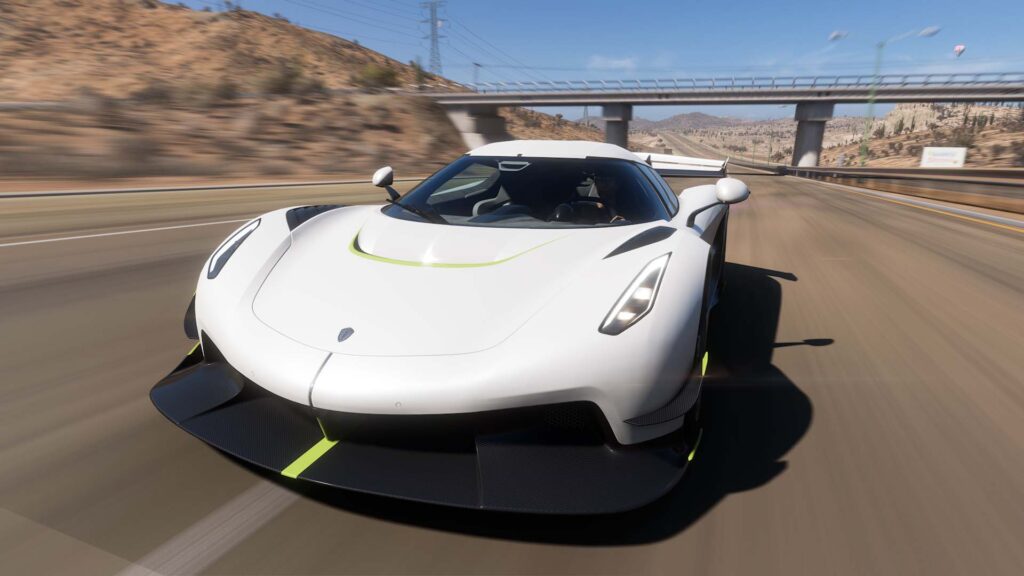
2020 Koenigsegg Jesko
When players talk about raw speed on tarmac, the Jesko is the car that comes up first, and for good reason. Horizon 5’s version is one of the fastest cars in the game and with the right tune, it’ll hit an eye-watering, space-time continuum ripping 380 mph. The Jesko sits comfortably in S2 class and represents the absolute ceiling of what paved road performance looks like in FH5. It’s expensive and demands smooth, deliberate inputs, but the reward is a car that simply obliterates straight-line competition.
Lamborghini Sesto Elemento Forza Edition
For players who want speed without sacrificing technical control, the Sesto Elemento Forza Edition is a standout. The Lamborghini Sesto Elemento reigns supreme as the handling king in Forza Horizon 5, scoring 10 points across Handling, Breaking, Launch, and Acceleration. At 2,500,000 credits it isn’t cheap, but the sheer breadth of what it does well — and its Skill Score multiplier during Skill Songs — makes it one of the most versatile S2 road racers available.
2017 Koenigsegg Agera RS
The Agera RS sits a step below the Jesko in price but not significantly in performance. The Koenigsegg Agera RS is firmly in S-tier among the FH5 community, offering near-hypercar speeds with slightly better mid-corner stability than the Jesko, making it more forgiving for players still mastering high-speed cornering.
Ferrari F50 GT (1996)
A surprising pick for many newer players, but the F50 GT has maintained its reputation across Forza titles. The classic 1996 Ferrari F50 GT still claims one of the top spots for handling and braking, scoring 10 in each category. Paired with the right suspension tune, it performs exceptionally well on technical circuits where braking zones and corner exit traction matter more than top speed.
🌲 Best for Dirt & Cross-Country Racing
Ford Bronco R (Welcome Pack Edition)
Cross-country racing is where the rules change entirely. Forget aerodynamics and slick tires — ground clearance, AWD traction, and suspension travel take priority. The Ford Bronco R excels here. Whether you get the Ford Bronco 2020 or claim the Ford Bronco R from your Welcome Pack, it is one of the best vehicles you can find for Cross-Country Racing… It can breeze through every obstacle with ease at high speed. The Bronco R’s suspension geometry handles rough Mexican terrain with confidence that few other vehicles can match.
Porsche 959
One of the more versatile picks across multiple disciplines, the 959 doesn’t just work on road — it shines on dirt too. The Porsche 959 offers one of the most versatile setups available, excelling across a range of classes from A to top-tier S2, whether on or off-road. Its legendary all-wheel-drive system, derived from the 1986 Paris-Dakar Rally car, translates naturally into FH5’s loose-surface events.
Hoonigan RS200
Ken Block’s connection to the RS200 is well documented in motorsport history, and in FH5, the Hoonigan version carries that off-road pedigree into dirt and rally events. It’s listed firmly among the game’s S-tier performers by community rankings, offering explosive acceleration and a tunable AWD system that can be dialed in for controlled oversteer on gravel stages.
⚡ Best for Drag Racing
2021 Rimac Nevera
Electric powertrains dominate drag racing in FH5, and the Nevera is the king of that world. The 2021 Rimac Nevera is an incredible set of wheels scoring high with a 9-speed stat, 9.2 in acceleration, and a crisp 10 in the launch stat. It’s the perfect companion for drag races and maxes out at around 303 MPH. Drag tuning a Nevera is relatively straightforward — the instant torque delivery does most of the work; the main variables are launch control settings and tire compound.
Hennessey Venom F5
For players who prefer internal combustion in the drag strip, the Venom F5 is the answer. The Hennessey Venom F5 is one of the best performers, clocking in a 10 in the speed stat and maxes out at around 302 MPH. With the right drag-specific tune focusing on launch settings, differential lock, and tire pressure adjustments, it trades close with the Nevera in shorter races.
🏆 Best All-Around Garage Must-Haves
BMW X5 M Forza Edition
The X5 M FE is one of those cars that defies expectations. An SUV with 10-rated stats across handling and braking in an S-class? The BMW X5 M Forza Edition is the top pick among S-tier cars in community rankings, valued for its Skill Point multiplier, its competitive speed, and the sheer novelty of dominating road races in what looks like a family hauler.
Nissan GT-R Black Edition
The GT-R has been a community favorite across multiple Forza titles, and FH5 is no different. The Nissan GT-R Black Edition is one of the best choices overall in Forza Horizon 5, offering high speed and acceleration without compromises in handling on the track. Starting in the S1 class, players can push this vehicle for great results even in S2. The Liberty Walk wide-body kit available for the GT-R also boosts its aerodynamic stats, making it aesthetically and mechanically one of the most satisfying builds in the game.
Bugatti Divo
When credits aren’t a constraint, the Divo earns its place. The Bugatti Divo is firmly in the S-tier, with the Bugatti Chiron costing 2,400,000 credits but being one of the fastest cars you can get in the game. The Divo takes the Chiron’s platform and adds sharper handling tuning from the factory, making it a better all-rounder for circuit-style road racing.
The Forza Horizon 5 Tuning System Explained
Understanding tuning is what separates a car that’s fast in theory from one that’s fast on the track you’re actually racing. Tuning lets players customize individual metrics on their car, including the amount of downforce applied by aerodynamic upgrades, the specific settings of their car’s suspension and handling platforms, even the specific gearing ratios for the engine.
The tuning menu is accessible from your garage and covers nine primary categories. Here’s what each one does and how to approach it:
Tires & Tire Pressure
Tire pressure directly influences how much of the tire’s contact patch is actually working. Lower pressure spreads the tire out, increasing grip at the cost of responsiveness. Higher pressure concentrates the contact patch, sharpening turn-in but reducing overall traction. In Forza Horizon, things are simple and most tire compounds used on the street operate fine between 170 and 250 °F (75-120 °C). The different compounds simply add more grip. For road racing, slick compound tires are the default high-performance choice. For dirt and cross-country, rally tires provide better off-road bite.
A general starting point: set front tire pressure around 28–30 PSI and rear around 26–28 PSI, then use telemetry (accessed via the d-pad in-game) to check whether your tire temperatures are balanced. If one corner is consistently hotter, adjust pressure accordingly.
Gearing
Gear tuning is where many players recover top speed that feels artificially capped. If you have added all of the power upgrades to your car, you can still increase your top speed by adjusting your gearing tuning. Move your final gear towards speed so the last gear touches the end of the graph.
For drag racing, shorten the gear ratios so the car hits peak power band quickly and shifts early. For top-speed runs on long straights, extend the final drive ratio. For circuit racing, space gears evenly so the engine stays near its power peak through the entire lap.
Alignment (Camber, Toe, Caster)
Alignment affects how the tire sits against the road surface. Negative camber (top of the tire tilted inward) improves cornering grip but can reduce straight-line traction. A general recommendation for road racing is -1.0° to -1.5° of camber front and rear. Toe-out at the front sharpens initial turn-in; toe-in at the rear adds stability at high speed. Caster adjustments affect steering feel and are typically left close to their default unless significant handling issues are present.
Anti-Roll Bars (ARBs)
ARBs control body roll when cornering. Stiffer ARBs reduce roll but can cause the car to skip over bumps, reducing grip. Softer ARBs allow more roll but keep the tires in better contact with uneven surfaces. For smooth track racing, stiffer ARBs (front slightly stiffer than rear) work well. For cross-country, soften both significantly. If you have too much oversteer exiting corners in FH5, you can soften rear ARBs as a starting adjustment.
Springs & Ride Height
Spring rate and ride height are interrelated. Lower ride height reduces aerodynamic drag and lowers the center of gravity — good for road racing. Higher ride height provides clearance for rough terrain — essential for cross-country. Start with a ride height that is low if you plan to drive on a smooth track or higher if the road surface will have more bumps and dips. Spring rates should be balanced with weight distribution: heavier front cars need stiffer front springs.
Dampers (Bump & Rebound Stiffness)
Dampers control how quickly the suspension responds to compression (bump) and extension (rebound). Rebound stiffness affects how quickly the car recovers from a bump; bump stiffness controls how harshly it absorbs one. In most FH5 setups, rebound should be stiffer than bump. A common starting ratio is rebound at roughly 60–70% of the available range and bump at 40–50%.
Aerodynamics
Aero tuning requires installing an adjustable front splitter and rear wing first. To be able to tune your downforce and aerodynamics, your car will need an adjustable front splitter, and an adjustable rear wing installed. More downforce = more grip and stability at high speed but more drag and lower top speed. For tight, technical road circuits, higher downforce settings help. For top-speed events on long straights, reduce downforce to minimize drag.
Brakes
Brake bias distributes braking force between front and rear axles. More front bias (e.g., 60% front) gives stronger stopping power but risks front lock-up. More rear bias improves rotation on corner entry but can cause snap oversteer under braking. Most players run between 55–65% front bias. Performance brake upgrades (race brakes) are typically worthwhile on any car where braking is a limiting factor.
Differential
The differential controls how power is distributed between driven wheels. A higher acceleration lock value pushes more power to both wheels under throttle, improving straight-line traction but reducing agility. A higher deceleration lock value adds stability under braking. For AWD cars, the center differential ratio allows you to bias drive toward front or rear axles — shifting toward the rear adds rotation and a more tail-happy feel, while biasing forward adds understeer stability.
🚀 Comparison Table: Top FH5 Cars at a Glance
| Car | Class | Best For | Top Speed (est.) | Handling Rating | Credits Cost |
|---|---|---|---|---|---|
| Koenigsegg Jesko (2020) | S2 | Road Racing / Top Speed | ~380 mph (tuned) | 9.5 | ~3,000,000 CR |
| Lamborghini Sesto Elemento FE | S2 | Road Racing / All-Round | ~230 mph | 10 | 2,500,000 CR |
| Rimac Nevera (2021) | S2 | Drag Racing | ~303 mph | 8.5 | ~2,800,000 CR |
| BMW X5 M Forza Edition | S2 | All-Round / Skill Score | ~225 mph | 10 | Event Reward |
| Porsche 959 | A–S2 | Off-Road / Versatile | ~200 mph (stock) | 8.0 | ~350,000 CR |
| Ford Bronco R | B–S1 | Cross-Country / Dirt | ~160 mph (tuned) | 7.5 | Welcome Pack |
| Hoonigan RS200 | S1 | Dirt / Rally | ~185 mph (tuned) | 8.5 | ~500,000 CR |
| Koenigsegg Agera RS (2017) | S2 | Road Racing | ~350 mph (tuned) | 9.0 | ~2,700,000 CR |
| Nissan GT-R Black Edition | S1–S2 | Road / Street | ~220 mph (tuned) | 9.0 | ~200,000 CR |
| Bugatti Divo | S2 | Road Racing | ~260 mph | 9.0 | ~2,800,000 CR |
Advanced Tuning Tips from the FH5 Community
The FH5 tuning community is one of the most active in racing gaming. Resources like the official Forza Community Forums host in-depth technical discussions from veteran tuners who have tested thousands of configurations across hundreds of cars. Here are patterns that consistently emerge:
Start with upgrades before tuning. Tuning a stock car yields limited results. Invest in a race engine swap, sport or race suspension, race tires, and appropriate brakes first. Taking an already-impressive stock car in Forza Horizon 5 and elevating it to new heights starts with the Upgrade Shop. You can replace and add a ton of different parts to FH5’s massive roster of vehicles, ranging from full-blown engine replacements and body kits to minor tweaks to handling and suspension.
Use community tunes as a baseline. Rather than starting from scratch, download a highly-rated community tune for your car from the garage, test it, and then adjust from that foundation based on how the car feels to you specifically. The ForzaLabs database provides performance data and upgrade combinations for over 350 vehicles and is a valuable reference before committing credits to upgrades.
Don’t ignore weight reduction. Weight-reduction upgrades (sport or race weight reduction) often provide more PI-efficient performance gains than power upgrades, particularly for handling-focused builds. A lighter car turns faster and brakes shorter — and for most race types outside drag racing, handling improvements win more races than raw power.
Telemetry is your best tuning tool. The in-game telemetry display (accessed via the directional pad) shows real-time suspension travel, tire temperatures, G-forces, and more. If your outside front tire is consistently overheating in corners, you likely need softer ARBs or more negative camber. If you’re bottoming out over crests, increase spring rate or raise ride height. The data doesn’t lie.
The ForzaTune app is widely used by the community as a calculator that generates spring rates, damper settings, and alignment numbers based on your car’s weight and setup. It dramatically reduces the trial-and-error phase of tuning and is particularly useful for players who want a solid mathematical baseline to build from.
Beware rally suspensions on road cars. In Horizon, do not install a rally suspension by accident — a common mistake on cars like the 911 GT3. Rally suspensions raise ride height and soften handling, which hurts road performance significantly.
Building a Competitive Garage on a Budget
Not every player has millions of credits to spend on S2 hypercars. The good news is that some of the most competitive builds in specific classes use relatively affordable cars with smart upgrade investment.
The Nissan GT-R Black Edition starts around 200,000 credits — remarkably accessible for an S1 car that can reach S2 performance with upgrades. The Porsche 959 is similarly versatile, and the Ford Bronco R is free from the Welcome Pack if you haven’t claimed it. These everyday cars shouldn’t be overlooked by players seeking affordable options with great upgrading potential.
The Ford Mustang GT (2024 variant) is another budget-friendly overperformer. Starting as an A-class vehicle, the Ford Mustang GT can dominate the A, S1, and S2 classes, going all the way to the top. Its wide-body kit options, engine swap potential, and flexible class range make it one of the best upgrade investments for players who want a car that grows with them across multiple PI classes.
For B and A class racing specifically — which dominates many Festival Playlist events — the Subaru Impreza 22B is a community staple. Its all-wheel-drive layout and balanced weight distribution make it easy to tune for consistent lap times. The 22B is a dream for racers seeking balance.
Common Mistakes to Avoid
Maxing PI without purpose. Always know what class cap the event you’re targeting uses. An over-upgraded car that exceeds the event’s PI limit is disqualifying — and a car unnecessarily close to the class ceiling may have poorly balanced upgrades.
Ignoring drivetrain conversions. Some cars become dramatically more competitive with a drivetrain swap. Converting a rear-wheel drive car to AWD in a lower class improves traction significantly, often with a modest PI cost. Conversely, stripping a naturally AWD car to RWD can save PI for power upgrades if the driver is confident in throttle control.
Over-tuning aerodynamics. Maximum downforce isn’t always optimal. On cars with strong enough mechanical grip from tires and suspension, heavy aero settings add drag without meaningful handling benefit. Test with reduced rear downforce and compare lap times.
Neglecting gear tuning after upgrades. Every engine or drivetrain upgrade shifts the car’s power band. After major upgrades, revisit the gearing setup to ensure gear spacing still matches the engine’s power characteristics.
Frequently Asked Questions (FAQ)
Q: What is the fastest car in Forza Horizon 5?
The Koenigsegg Jesko holds the top speed crown in FH5. With the right tune and optimal conditions on a long straight, it can exceed 300 mph and in some player-tested configurations approach the high 300s. The Bugatti Chiron Super Sport and Hennessey Venom F5 are also contenders at the very top of S2 speed.
Q: How do I unlock tuning options that are greyed out?
Greyed-out tuning settings indicate that a tunable part hasn’t been installed yet. For example, aerodynamic tuning requires an adjustable front splitter and rear wing. Head to the Upgrade Shop and install the relevant adjustable components to unlock those tuning parameters. Some tuning options are locked for road cars — you can unlock these by purchasing adjustable upgrades for each individual car.
Q: Should I use community tunes or make my own?
Both have value. Community tunes — especially those from high-rated tuners — are excellent starting points and are often the fastest route to a competitive setup. However, tuning your own cars allows you to match the setup to your specific driving style. A tune that works for an aggressive driver may not suit someone with a smoother, more methodical approach. Use community tunes as reference, but don’t be afraid to modify them.
Q: What’s the difference between upgrading and tuning?
Upgrading replaces or improves physical components — engine, intake, suspension parts, tires, etc. — and changes the car’s stats and PI rating. Tuning adjusts the settings within those components (spring rates, pressure, differential lock %, etc.) without changing PI. Both are necessary for a fully optimized build.
Q: Is AWD always better than RWD in FH5?
AWD provides better traction and is generally more forgiving, particularly in wet conditions or on loose surfaces. However, AWD conversions cost PI and can reduce a car’s peak performance potential within a class. Skilled drivers often prefer RWD for its lower PI cost and more responsive handling characteristics — freeing up PI budget for more power or weight reduction.
Q: How do I find the best tune for a specific car without building one myself?
In the garage, select a car and go to the Tune section. Choose “Search Shared Tunes” and sort by downloads or likes. Community-made tunes from experienced players are searchable by gamertag and class. The Forza community forums also host tuning discussion threads for popular vehicles.
Q: What car should a beginner start with?
The Hoonigan Ford Cosworth (the starter car) is actually excellent for early game. As Ken Block commissioned it, for whom sideways is standard, this thing handles beautifully whether off-road or on, making it a versatile tool for high speed commutes between events. From there, the Ford Bronco R (Welcome Pack) and Nissan GT-R Black Edition offer excellent value for players building their garage.
Q: How do I maximize Skill Score in FH5?
Skill Score is boosted by Forza Edition cars, which carry a Skill multiplier. The BMW X5 M Forza Edition and Lamborghini Sesto Elemento Forza Edition are among the highest multipliers available. Driving near traffic, performing near-misses, drifting, and achieving air time all contribute to the Skill chain.
Q: Does car class matter for online multiplayer?
Yes, significantly. Most online event lobbies specify a class (A, S1, S2, etc.) and often a specific discipline (road, dirt, cross-country). Bringing a well-tuned car that maximizes PI within the event’s cap — rather than just the most expensive car — is the competitive approach in multiplayer.
Conclusion: Building Mastery in Mexico’s Open Road
Forza Horizon 5 rewards the player who commits to understanding both their car and the terrain it’s racing on. The game’s massive roster — now well past 860 vehicles and growing — means there’s no shortage of choice, but choice without context is just noise. Knowing that the Koenigsegg Jesko dominates asphalt but would be humiliated on a cross-country trail, that the Ford Bronco R punches far above its price in dirt events, or that the Rimac Nevera’s instant torque makes it nearly unbeatable off the line in drag racing — this kind of knowledge is what translates into consistent wins.
The tuning system adds another dimension entirely. As resources like Windows Central’s FH5 tuning guide and SimRacingSetup’s comprehensive breakdown demonstrate, every variable in the setup menu has a logical cause-and-effect relationship that can be learned, practiced, and mastered without any prior engineering background. The telemetry data makes that learning loop tight and iterative — you tune, you drive, you observe, and you adjust.
For players building out their garage, the priority should be versatility first: a capable cross-country vehicle (Bronco R or Porsche 959), a competitive S1 road racer (GT-R or Agera RS), and an off-road dirt specialist (RS200 or similar). From there, expand into drag builds and event-specific machines as credits and experience accumulate.
The tuning philosophy to carry forward is simple: tune for the track, not for the specs screen. A car with a slightly lower PI ceiling but a well-balanced setup will outperform a maxed-out build with poorly calibrated dampers and mismatched gearing every time. Lap times don’t lie, and Mexico’s 550 square kilometers of varied terrain will test every car and setup in ways the spec sheet can’t predict.
Whether you’re chasing Horizon Festival events, grinding Forzathon challenges, or competing in online lobbies, the combination of the right car and a thoughtful tune is the most reliable path to the top of the leaderboard. The tools are all there — in-game telemetry, community tunes, the upgrade shop, and a wealth of player knowledge accumulated across four-plus years of FH5’s lifespan. The only variable left is how much time you’re willing to put into the garage.