The trajectory of Cyberpunk 2077 from its highly publicized launch in 2020 to its current standing in 2026 is one of the most remarkable transformations in the modern gaming industry. Initially marred by technical inconsistencies and unfulfilled promises, the title has undergone years of relentless development, systemic overhauls, and narrative expansions. Today, the game stands as a premier example of the open-world action RPG genre, fully realizing the ambitious vision initially set forth by CD Projekt Red.
For gamers evaluating whether to step into the neon-lit streets of Night City in 2026, the short answer is an unequivocal yes. However, understanding exactly why the game is worth the investment requires a deep dive into the mechanical changes, the impact of its monumental expansion, and the state of its technological performance on modern hardware. This comprehensive review examines every facet of Cyberpunk 2077 in its definitive, modernized form, providing an objective analysis of its gameplay, narrative depth, and overall value.
The Radical Overhaul: How Night City Was Rebuilt
The version of Cyberpunk 2077 available in 2026 is fundamentally different from the 2020 release. The turning point for the game’s systemic architecture arrived with the massive 2.0 update, followed by subsequent refinements up to patch 2.12 and beyond. These updates did not merely fix bugs; they dismantled and reconstructed core gameplay loops.
Redefined Cyberware and Progression Systems
One of the most significant changes involves how players build and upgrade the protagonist, V. The original system tied armor statistics to clothing, forcing players to choose between aesthetic appeal and survivability. In the modernized version, armor is intrinsically linked to the cyberware installed in the character’s body. Clothing is now purely cosmetic, allowing for maximum visual customization without penalizing combat effectiveness.
Furthermore, the game introduces a Cyberware Capacity system. Installing powerful chromium enhancements like the Sandevistan operating system or Gorilla Arms now comes with a capacity cost. Pushing the human body past its limits unlocks specific high-tier perks but requires careful management, perfectly mirroring the deep-rooted lore of the tabletop game where over-modification carries severe risks.
Dynamic Combat and Vehicular Warfare
Combat fluidity has seen massive improvements. The introduction of vehicular combat allows players to engage in high-speed shootouts across the badlands or the dense urban grid of Night City. Players can hack enemy vehicles, shoot out tires, or utilize weaponized cars equipped with built-in machine guns and missile launchers.
The police AI, once a heavily criticized aspect of the game, has been entirely rebuilt into a dynamic, escalating threat system. Minor infractions draw the attention of local beat cops, but sustained criminal activity triggers a full-scale response. At the maximum wanted level, heavily armored MaxTac units deploy from aerial dropships, presenting a formidable, boss-level challenge that tests the limits of any high-level character build.
Phantom Liberty: A Masterclass in Expansion Design
No review of Cyberpunk 2077 in 2026 is complete without analyzing the critically acclaimed Phantom Liberty expansion. Released in 2023, this expansion is permanently woven into the fabric of the modern Cyberpunk experience.
The Espionage Thriller Narrative
Phantom Liberty introduces Dogtown, a walled-off, highly militarized sub-district of Pacifica. The narrative pivots from the base game’s street-mercenary hustle to a high-stakes espionage thriller. Featuring complex characters like FIA agent Solomon Reed, the expansion weaves a narrative of loyalty, betrayal, and political maneuvering. The writing in this expansion is widely considered some of the best in the RPG genre, offering branching choices that lead to drastically different, emotionally resonant conclusions.
The Relic Skill Tree
Mechanically, the expansion introduces the Relic Skill Tree, which fundamentally enhances existing playstyles. For example, players utilizing Mantis Blades can unlock the ability to perform devastating, long-range leaping strikes. Those favoring stealth can utilize optical camo enhancements to exit combat instantly. These additions ensure that character progression remains engaging well into the endgame, providing tools that synergize perfectly with the base game’s skill overhaul.
Role-Playing Depth and Build Diversity in 2026
A core pillar of any great RPG is the ability to approach challenges through diverse methodologies. Cyberpunk 2077 currently excels in offering distinct, viable playstyles that drastically alter how encounters unfold. The perk trees have been streamlined to remove passive, uninteresting stat boosts in favor of active abilities that change the flow of combat.
- The Netrunner: Operating as a futuristic combat-mage, Netrunners manipulate the battlefield through Quickhacks. In the modern build, players can queue multiple hacks on a single target, creating devastating combinations. For instance, uploading a “Contagion” hack followed by an “Overheat” hack causes a highly explosive chemical reaction, clearing rooms without a single bullet fired.
- The Chrome-Junkie Bruiser: Utilizing Blunt Weapons, Shotguns, and the Berserk operating system, this archetype thrives on close-quarters brutality. The revamped perks allow for throwing enemies, triggering localized earthquakes with heavy melee strikes, and regenerating health through aggressive actions.
- The Sandevistan Shinobi: Popularized by the successful Edgerunners anime adaptation, this build focuses on time-dilation. By activating a Sandevistan implant, players can slow time to a crawl, utilizing katanas or throwing knives to dispatch entire squads of enemies before they can even draw their weapons.
The flexibility to respec attribute points and perks ensures that players are never locked into a playstyle that they no longer find enjoyable, encouraging continuous experimentation.
Visual Fidelity and Technological Benchmarks
Cyberpunk 2077 has always pushed the boundaries of graphical fidelity, but in 2026, it serves as a definitive benchmark for modern hardware capabilities. The developers have continuously collaborated with hardware manufacturers to integrate cutting-edge rendering techniques.
Path Tracing and the Overdrive Update
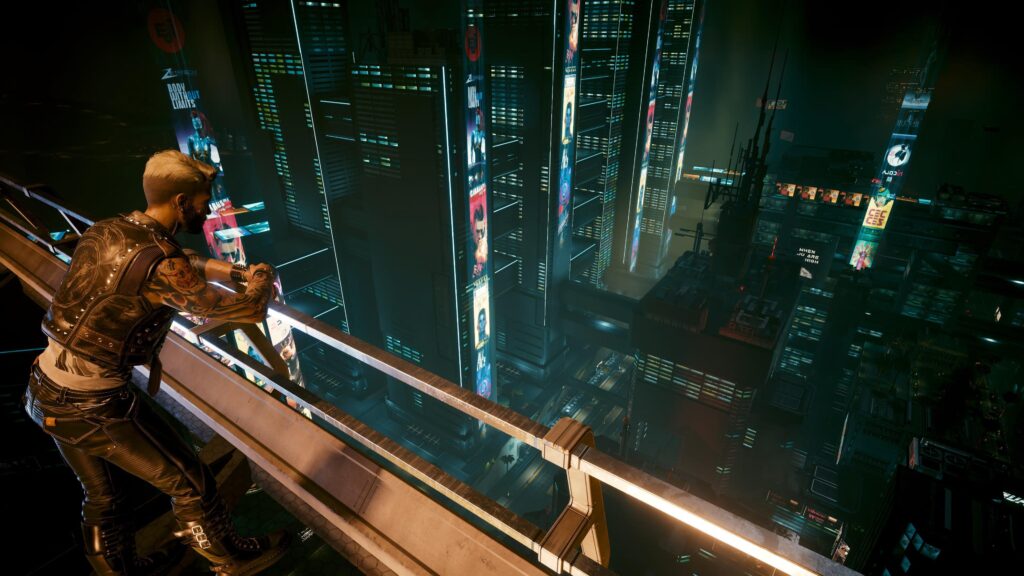
For PC enthusiasts utilizing high-end graphics cards, the game offers an Overdrive Mode that utilizes Nvidia’s Path Tracing technology. Unlike standard ray tracing, which only calculates lighting for specific elements like puddles or shadows, path tracing simulates the physical behavior of light across the entire scene. Neon signs accurately illuminate the rain-slicked pavement, light bounces naturally through the smog-filled alleys of Kabuki, and character models exhibit incredibly realistic skin shading.
To maintain playable frame rates with such demanding technology, the game heavily utilizes upscaling technologies like DLSS 3.5 and Frame Generation, creating a visually stunning experience that remains remarkably fluid.
Console Performance in the Modern Era
On current-generation consoles (PlayStation 5 and Xbox Series X), the game offers rock-solid performance modes targeting 60 frames per second, alongside a 30 FPS Ray Tracing mode that enhances localized shadows and reflections. The addition of the game to subscription services like Xbox Game Pass has only further solidified its accessibility, allowing a broader audience to experience the high-fidelity world without a premium upfront cost. Optimization across all modern platforms is stringent, leaving the instability of the 2020 launch firmly in the past.
The Living Ecosystem of Night City
Beyond the combat and the graphics, the true star of the game remains Night City itself. In its fully updated state, the city feels like a living, breathing ecosystem rather than a static backdrop.
The implementation of dynamic events creates unpredictable emergent gameplay. Players traversing the city might stumble upon a spontaneous shootout between the heavily armed Maelstrom gang and corporate security forces. Intervening in these skirmishes can yield unique loot and resources. Furthermore, fixers and vendors now text the player organically, offering discounts on vehicles or unique weapon schematics based on the player’s street cred and previous mission choices.
The ambient details have also seen massive improvements. NPC routines are more complex, traffic flows more naturally, and the atmospheric audio design—from the distant wail of sirens to the thumping bass of underground clubs—cements a level of immersion matched by very few open-world titles. The consistent player base metrics observed throughout the years highlight just how compelling this world remains for both new and returning players.
The Modding Community’s Role in Longevity
While console players receive a highly polished, feature-complete package, the PC ecosystem benefits immensely from a thriving modding community. CD Projekt Red’s official support for modding tools has allowed creators to expand the game’s lifespan exponentially.
In 2026, the modding scene offers everything from hyper-realistic 4K texture overhauls to deep systemic changes. Popular mods introduce survival mechanics—requiring V to eat, sleep, and drink—adding a hardcore role-playing layer to the experience. Other prominent mods completely overhaul vehicle handling physics, introduce custom radio stations, or add entirely new cosmetic cyberware options. This symbiotic relationship between the developers and the community ensures that Night City continues to evolve long after official development has transitioned to the studio’s next project.
📊 Feature Evolution: Launch State vs. Current Era
To fully grasp the magnitude of the game’s transformation, it is highly useful to contrast the original release with the comprehensive state of the game in 2026.
| Core Feature | 2020 Launch State | 2026 Current State | Impact on Gameplay |
| Police System | Teleporting law enforcement, static threat. | Fully dynamic escalation, vehicular chases, MaxTac deployments. | Increases open-world immersion and provides high-level combat challenges. |
| Skill & Perk Trees | Bloated with passive percentage increases (e.g., +5% damage). | Streamlined into active abilities (e.g., air dashing, bullet deflection). | Completely revolutionizes combat pacing and build variety. |
| Armor System | Tied directly to clothing; forced visual mismatch for optimal stats. | Tied to internal cyberware; clothing is strictly cosmetic. | Allows for ultimate visual customization without sacrificing survivability. |
| Vehicular Gameplay | Strictly a method of travel; clunky handling. | High-speed combat, hacking enemy cars, weaponized vehicles. | Adds an entirely new dimension to open-world exploration and combat. |
| Performance | Frequent crashes, severe optimization issues on older hardware. | Highly optimized, stabilized frame rates, advanced Path Tracing on PC. | Delivers a seamless, technologically advanced visual experience. |
Frequently Asked Questions (FAQ)
Is it necessary to play the Phantom Liberty expansion?
While the base game offers a complete and satisfying narrative on its own, Phantom Liberty is highly recommended. It seamlessly integrates into the mid-game, providing some of the best quest design, boss fights, and equipment available. It is widely considered an essential part of the definitive Cyberpunk 2077 experience.
Can older generation consoles (PS4, Xbox One) run the 2026 version of the game?
No. CD Projekt Red ceased updating the PlayStation 4 and Xbox One versions of the game prior to the release of the massive 2.0 update and Phantom Liberty. To experience the overhauled mechanics, advanced AI, and the expansion, players must use a PlayStation 5, Xbox Series X/S, or a capable PC.
How long does it take to complete the game with all its modern content?
A focused playthrough of the main storyline will take approximately 25 to 30 hours. However, engaging with the high-quality side quests, companion storylines, and the Phantom Liberty expansion will easily push the playtime to 70–90 hours. Completionists exploring every gig and scanner hustle can expect upwards of 120 hours of content.
Do the initial Lifepath choices (Nomad, Streetkid, Corpo) matter in the long run?
The Lifepath choice heavily influences the game’s prologue and provides unique dialogue options throughout the entire campaign. While it does not drastically alter the main plot trajectory, these unique dialogue choices can open alternate ways to complete specific quests or bypass combat encounters, adding a distinct flavor to each playthrough.
Does the game feature a multiplayer mode?
No. Despite early rumors during the game’s initial development cycle, Cyberpunk 2077 is a strictly single-player, narrative-driven experience. The developers ultimately focused all their resources on perfecting the single-player world, a decision that is reflected in the high quality of the current game.
Final Verdict and Next Steps
Evaluating Cyberpunk 2077 in 2026 requires looking past the historical context of its turbulent launch and examining the software as it stands today. The culmination of relentless updates, the integration of community feedback, and the stellar addition of Phantom Liberty has resulted in a towering achievement in the RPG space.
The game successfully balances a deeply personal, emotionally resonant narrative with chaotic, high-octane combat and unparalleled visual design. It offers a level of immersion and player agency that few other titles on the market can match. Whether calculating the optimal quickhack sequence to quietly dismantle a corporate facility, or engaging in a high-speed vehicular firefight through the dusty roads of the Badlands, the gameplay loop remains consistently engaging.
For those who have yet to experience Night City, or for returning players who have not stepped foot in the game since its early days, 2026 is the perfect time to plug in. The world is fully realized, the systems are deeply refined, and the technological foundations are rock-solid. Cyberpunk 2077 is no longer a cautionary tale of industry overambition; it is a masterclass in redemption and a mandatory experience for any serious fan of the role-playing genre.
Players looking to begin their journey should seek out the Ultimate Edition, which bundles the base game and the expansion, ensuring access to the entirety of the modernized content from the moment they boot up the game. Dive into the character creator, experiment with the new perk systems, and prepare to lose dozens of hours to one of the most meticulously crafted fictional cities in gaming history.