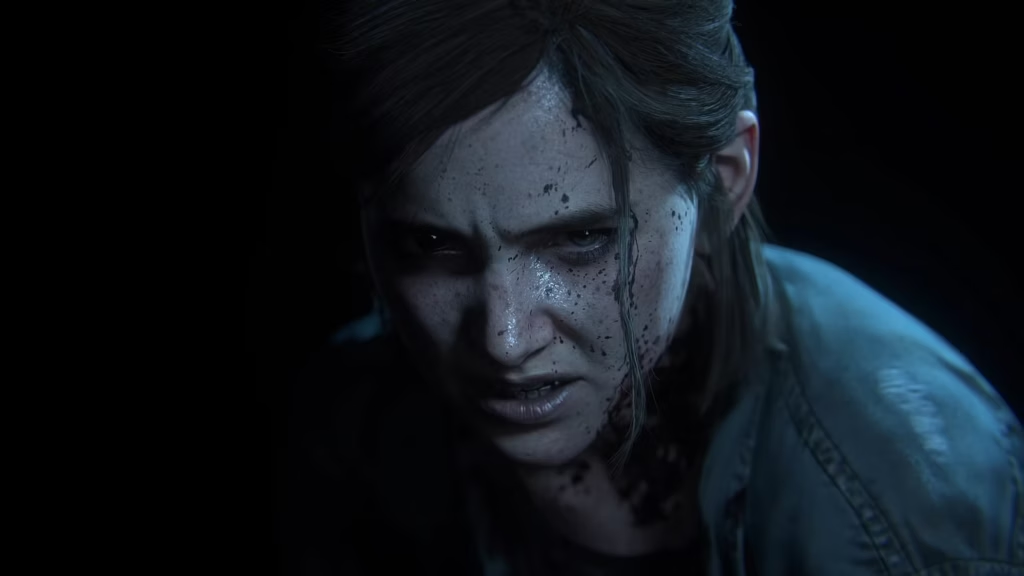
The Last of Us Part II stands as one of the most ambitious and technically accomplished action-adventure games of its era, building directly on the foundation established by its 2013 predecessor while introducing significant advancements in storytelling, gameplay systems, and world-building. Released in June 2020 by Naughty Dog and published by Sony Interactive Entertainment for PlayStation 4, the title quickly earned widespread critical recognition, achieving a Metacritic score of 93 based on over 120 professional reviews that highlighted its narrative ambition and refined mechanics.
Set five years after the events of the original game, The Last of Us Part II follows characters navigating a post-apocalyptic United States still ravaged by a fungal infection that turns humans into aggressive infected creatures. The story centers on themes of revenge, the cycle of violence, and the moral complexities that arise when personal loss drives extreme actions. As outlined on the official PlayStation game page, players experience the escalating moral conflicts created by a relentless pursuit of justice, challenging perceptions of right versus wrong, good versus evil, and hero versus villain in a world where survival often demands difficult choices.
The narrative structure deliberately expands the scope beyond the intimate father-daughter dynamic of the first game, incorporating multiple perspectives and a larger cast to illustrate how violence perpetuates itself across communities and individuals. This approach creates a layered exploration of human resilience and fragility, with branching character arcs that reflect real-world patterns of trauma and retaliation observed in conflict-driven societies. Critics noted the script’s maturity in handling these elements, as seen in analyses from sources like the IGN review, which praised how the game subverts genre tropes while delivering profound emotional payoffs through its unalterable story beats.
Gameplay in The Last of Us Part II evolves the survival-action formula into a more fluid and responsive experience, emphasizing player agency within tightly designed encounters. The core loop revolves around stealth, combat, exploration, and resource management in a hostile environment filled with both infected threats and hostile human factions. Players control a protagonist capable of high-intensity melee engagements, dynamic stealth takedowns, and improvised solutions that reward careful planning over brute force.
One of the most notable mechanical upgrades involves enhanced traversal and mobility options. The addition of a dedicated jump mechanic, combined with the ability to go prone in tall grass or under vehicles, allows for greater environmental interaction and tactical flexibility. These features transform open combat arenas—such as overgrown Seattle streets or multi-level urban ruins—into dynamic playgrounds where players can climb, swing on ropes, or crawl to reposition without detection. Enemy AI demonstrates advanced reactivity, with human opponents calling out names, flanking positions, and adapting to player actions in ways that create emergent tension. Infected variants, including new types like the acid-spitting Shamblers, require specific countermeasures, forcing players to balance aggression with conservation of limited ammunition and crafting materials.
Crafting and skill progression further personalize the experience. Scavenged resources enable upgrades to weapons, such as improved stability or added scopes, while a branching skill tree lets players invest earned points into categories like stealth, health regeneration, or weapon handling. This system encourages repeated playthroughs on higher difficulties, where scarcity heightens the stakes and observed patterns of enemy behavior become critical for success. Detailed breakdowns in technical analyses, including those from Digital Foundry, highlight how motion-matching animation technology contributes to the realism of these interactions, blending hundreds of captured movements for seamless character control.
Exploration remains integral, with semi-open environments packed with collectibles, optional encounters, and environmental storytelling. Players might discover journals or artifacts that provide context on survivor groups like the WLF or the Seraphites, adding depth without disrupting the main path. The pacing alternates between intense action sequences and quieter moments of navigation, creating a rhythm that mirrors the unpredictability of survival in a reclaimed natural world.
Visually, The Last of Us Part II represents a high point for PlayStation 4 hardware, with meticulously detailed character models, dynamic lighting, and lush overgrown landscapes that contrast the decay of civilization. Facial animations capture subtle expressions that enhance performances, while particle effects and physics simulations during combat add weight to every encounter. Audio design excels through immersive soundscapes, realistic weapon feedback, and a haunting score that underscores emotional beats. Voice acting delivers nuanced portrayals across the cast, contributing to the game’s reputation for cinematic quality.
Accessibility options stand out as comprehensive, including features like infinite ammo aids, customizable controls, and descriptive audio, making the experience more inclusive for a broad audience. These elements align with industry standards for thoughtful design, allowing players of varying abilities to engage fully with the content.
Reception to The Last of Us Part II reflected strong critical praise for its technical and narrative achievements, though the story’s handling of violence and character motivations sparked divided opinions among players. Many outlets, including the Forbes review, acknowledged the game’s beauty in world design and gameplay while critiquing its darker tonal choices. Similarly, the Kotaku review described the experience as deliberately exhausting in its portrayal of brutality, noting how resource scarcity and relentless encounters amplify the theme of survival’s cost.
The title earned over 300 Game of the Year awards and nominations, underscoring its impact on the medium. However, user scores on platforms like Metacritic showed more polarization, with debates centering on narrative expectations versus the executed vision of moral ambiguity.
The Last of Us Part II Remastered: Enhanced Experience on Modern Hardware
In January 2024, The Last of Us Part II Remastered arrived for PlayStation 5, offering native enhancements and new content that make it the definitive version. Graphical upgrades include higher texture resolutions, improved shadows, and increased level-of-detail distances, alongside performance options for 4K fidelity or unlocked frame rates with VRR support. DualSense controller integration adds haptic feedback and adaptive triggers for heightened immersion in weapon handling and environmental interactions.
A standout addition is the No Return mode, a roguelike survival experience featuring randomized encounters, boss battles, and unlockable characters with unique traits. This mode extends replayability significantly, allowing players to test skills across familiar locations with modifiers that alter difficulty. Additional features include lost levels—early development builds of unused content—along with developer commentary tracks and an enhanced photo mode. For existing owners, the upgrade path provides substantial value at a modest cost, as noted in remastered analyses from outlets like Seasoned Gaming.
Key Improvements in The Last of Us Part II Compared to the Original
The following table illustrates core advancements in gameplay and design, drawing from observed evolutions in mechanics and player feedback across both titles.
| Feature | The Last of Us (2013) | The Last of Us Part II (2020) | Impact on Gameplay |
|---|---|---|---|
| Mobility and Traversal | Basic climbing and limited jumping | Jump button, rope swinging, prone crawling | Greater tactical options in open arenas |
| Enemy AI | Pattern-based responses | Reactive communication, flanking, environmental awareness | Heightened tension and replayability |
| Combat Systems | Melee and shooting with basic stealth | High-intensity melee, dodge, human shield mechanics | More fluid improvisation and personalization |
| Skill Progression | Linear upgrades | Branching skill tree across multiple disciplines | Encourages diverse playstyles and experimentation |
| World Design | Linear corridors with some exploration | Semi-open environments with layered verticality | Deeper immersion and discovery |
| Accessibility Options | Standard controls | Extensive suite including audio cues and assists | Broader audience accessibility |
This comparison highlights how Part II refines the formula without abandoning its roots, resulting in encounters that feel more dynamic and consequential.
FAQ: Common Questions About The Last of Us Part II
Is The Last of Us Part II suitable for newcomers to the series?
The game includes recaps and contextual details that provide sufficient background, though familiarity with the original enhances emotional resonance. New players can still appreciate the standalone narrative and gameplay on its own merits.
How long does it take to complete the main story?
A standard playthrough typically spans 25-30 hours, with additional time required for exploration, collectibles, or higher difficulty settings. Side content and multiple endings extend this further.
Does the Remastered version justify an upgrade?
For PlayStation 5 owners, the graphical improvements, faster load times, No Return mode, and lost levels offer meaningful enhancements, especially at the upgrade price point. First-time players benefit from the complete package.
What platforms support The Last of Us Part II?
Originally a PlayStation 4 exclusive, the Remastered edition runs natively on PlayStation 5 with backward compatibility options available for the base version.
Are there significant differences in difficulty across modes?
Higher difficulties reduce resources and increase enemy aggression, rewarding mastery of stealth and resource management. Accessibility assists allow customization without altering core challenge.
How does the game handle mature themes?
Content includes intense violence, strong language, and depictions of psychological trauma consistent with its post-apocalyptic setting. Parental guidance is recommended for younger audiences.
Does The Last of Us Part II feature multiplayer?
The title remains a single-player focused experience, with no online modes included.
Conclusion: Why The Last of Us Part II Remains a Landmark Title
The Last of Us Part II delivers a compelling blend of refined gameplay, technical excellence, and thought-provoking storytelling that continues to influence the action-adventure genre years after launch. Its exploration of revenge’s repercussions, supported by innovative mechanics and a richly detailed world, offers players a challenging yet rewarding journey through moral gray areas and survival realities. Whether experiencing the original or the enhanced Remastered edition, the game demonstrates how interactive media can provoke reflection on broader human patterns of conflict and redemption.
For those seeking a deep, mechanically engaging experience backed by strong production values, The Last of Us Part II provides lasting value through its replayability and layered design. The inclusion of new modes in the Remastered version further solidifies its place as an essential title for fans of narrative-driven games. Exploring the full scope of its content reveals why it earned such acclaim, inviting repeated engagements that uncover fresh insights with each playthrough. As the series progresses, this entry sets a high bar for future installments, emphasizing the power of cohesive world-building and player-driven tension in crafting unforgettable experiences.